Plasma and oxy-fuel cutting tables operate in an environment where heat, water, exposed metal, slag, contamination, and continuous production all create maintenance challenges. The fluid inside a cutting table is therefore doing more than simply filling the reservoir. It can influence corrosion control, cleanliness, odor, residue, equipment condition, and the amount of maintenance required to keep the system productive.
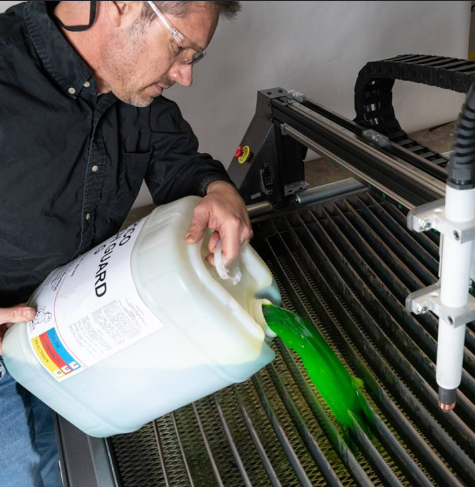
PICO Quench Guard G is a cutting table coolant, conditioner, and corrosion inhibitor developed specifically for plasma and oxy-fuel cutting table systems. PICO lists the product for ferrous, non-ferrous, stainless, galvanized, and aluminum surfaces, with an oil-free, wax-free, silicone-free formulation designed for clean-running table operation.
For fabrication shops considering the product, the question is not simply whether Quench Guard G has advantages. The more important question is whether those advantages match the operation’s equipment, materials, production environment, and maintenance objectives.
What Is PICO Quench Guard G?
PICO Quench Guard G is a specialized cutting table fluid used to cool hot metal, condition the cutting table reservoir, and provide corrosion protection for workpieces and system components.
Unlike plain water, a formulated plasma and waterjet fluid is designed to address additional problems that develop inside industrial cutting systems. These include corrosion, bacterial activity, odor, tramp oil contamination, and residue accumulation. PICO describes Quench Guard G as biodegradable, non-toxic, non-VOC, non-flammable, oil-free, and designed to leave clear, dry, non-staining protection.
That combination makes the product particularly relevant to fabrication operations where a cutting table runs regularly and the condition of both the table and the finished metal matters.
Pros and Cons of PICO Quench Guard G at a Glance
| Potential Advantage | Operational Impact |
| Corrosion inhibition | Helps protect tables, components, and metal workpieces |
| Supports ferrous and non-ferrous metals | Useful for shops processing multiple common metal types |
| Oil-, wax-, and silicone-free | Helps maintain a cleaner process without introducing those materials |
| Biostable formulation | Helps control bacteria and odor in frequently used systems |
| Clear, non-staining protection | Supports cleaner finished surfaces |
| Weld-safe formulation | Does not require removal before welding according to PICO |
| Broad cutting-table functionality | Cooling, conditioning, and corrosion control are handled by one fluid |
The primary limitations are equally important. Quench Guard G is a specialized cutting table fluid rather than a universal industrial coolant. It still requires proper system maintenance, and specific operating environments may require another product designed for torch circulation, waterjet conditioning, machining, or freeze protection.
Pro: Strong Corrosion Protection for Cutting Tables and Workpieces
One of the most important advantages of PICO Quench Guard G is corrosion control.
Water-based cutting tables naturally create prolonged exposure between metal, water, oxygen, heat, and contaminants. Plain water does not provide the same corrosion-inhibiting chemistry as a formulated cutting table conditioner.
PICO states that Quench Guard G provides corrosion protection for both workpieces and cutting table components.
For an organization, that matters because rust creates problems beyond appearance. Corrosion can increase maintenance requirements, affect equipment condition, contaminate the reservoir, and create unnecessary work around finished parts.
A properly selected cutting table fluid becomes part of the organization’s preventive maintenance strategy rather than simply another chemical expense.
Pro: It Can Be Used Across Several Common Metal Types
Fabrication operations rarely cut only one material forever.
PICO Quench Guard G is designed for ferrous and non-ferrous metals and is specifically listed for steel, stainless steel, galvanized material, and aluminum.
That broad material coverage can be valuable for job shops and manufacturers that regularly change production schedules.
Using chemistry compatible with the metals moving through the operation can simplify fluid management compared with environments where different materials create different fluid requirements.
Compatibility should still be evaluated against the complete production process, particularly when specialized alloys, coatings, downstream treatments, or unusual operating conditions are involved.
Pro: The Fluid Is Designed to Run Cleanly
Cutting table maintenance can become expensive when contamination accumulates.
Quench Guard G is formulated without oil, wax, or silicone. PICO also states that the product helps prevent tramp oil buildup, odor, and bacteria inside daily-use cutting systems.
This is an operational benefit because fluid cleanliness affects more than how the reservoir looks.
Dirty or poorly maintained table fluid can contribute to odors, residue, additional cleaning, and more frequent maintenance intervention. A fluid designed around cleaner operation can help reduce some of the conditions maintenance teams otherwise have to manage manually.
PICO also offers dedicated cutting table coatings and cleaners for operations that need additional control over slag, dross, grease, oil, and table contamination.
Pro: It Supports Downstream Welding Operations
Fabricators need to think about what happens after a part leaves the cutting table.
A coolant that creates problematic surface residue can shift work downstream. Parts may require additional cleaning before welding, coating, pickling, or another manufacturing step.
PICO describes Quench Guard G as weld-safe and non-interfering with pickling, while also producing clear, dry, non-staining protection.
That characteristic can help keep the cutting operation from creating an unnecessary secondary cleanup problem.
The broader lesson is important: cutting table fluid selection should never be evaluated only inside the cutting table. Manufacturers should consider the complete production sequence.
Pro: One Product Addresses Several Cutting Table Problems
Quench Guard G combines several functions into one chemistry.
It serves as a:
- Coolant
- Cutting table conditioner
- Corrosion inhibitor
- Rust preventive
- Fluid designed to help control bacterial activity and odor
For a production organization, consolidating those functions can simplify fluid management.
Maintenance teams have fewer variables to manage when one properly selected product handles several related requirements. Purchasing may also benefit from a more standardized chemical program rather than relying on separate improvised treatments for cooling, corrosion, and reservoir condition.
PICO groups Quench Guard G within its broader range of cutting table fluids, which includes dedicated fluids, cleaners, slat coatings, anti-spatter products, torch coolants, and freeze-control products for different cutting system requirements.
See also: Custom Sweatshirts and Their Role in Modern Brand Marketing
Con: Quench Guard G Is Not a Universal Coolant
The biggest potential disadvantage is also relatively straightforward: organizations should not treat Quench Guard G as the correct fluid for every piece of cutting equipment.
Its primary application is plasma and oxy-fuel cutting tables.
That is different from the internal cooling circuit of a plasma torch, for example. PICO manufactures PICO PTC 730 plasma torch coolant specifically for plasma cutting and welding torch circulation systems.
Likewise, PICO’s cutting table product range includes a separate waterjet table conditioner and other specialized fluids.
Using the right product in the right part of the system matters. A manufacturer should confirm the actual application before purchasing based simply on the word “coolant.”
Con: It Does Not Eliminate Cutting Table Maintenance
Another mistake would be assuming that a quality conditioner makes the cutting table maintenance-free.
It does not.
PICO states that Quench Guard G can support long tank life when properly maintained.
Slag still accumulates. Contamination can still enter the reservoir. Fluid conditions still need to be monitored. Equipment still requires scheduled cleaning and maintenance.
The benefit of a specialized cutting table fluid is that it supports the maintenance program. It does not replace one.
Organizations evaluating Quench Guard G should therefore consider how operators currently maintain fluid condition, remove contamination, clean the table, and manage the reservoir over time.
Con: Specialized Environments May Require Different Chemistry
Some operating conditions demand capabilities beyond the core purpose of Quench Guard G.
Cold-weather cutting environments are one example. PICO offers PICO Thermal HTF 100 specifically as a glycol-based fluid for plasma and waterjet systems requiring freeze protection and thermal stability.
Machining centers can create another distinction. PICO Quench Guard 55 is positioned for both plasma cutting tables and machining centers, whereas Quench Guard G is primarily positioned around plasma and oxy-fuel cutting tables.
These alternatives are not disadvantages in the conventional sense. They demonstrate why chemical selection needs to start with the actual process.
A manufacturer receives the greatest value when the chemistry matches the job it is being asked to perform.
How Can an Organization Benefit From PICO Quench Guard G?
The greatest organizational benefit comes from treating cutting table chemistry as part of production reliability.
For the right plasma or oxy-fuel operation, Quench Guard G can support several operational priorities at once:
Reduced Corrosion Exposure
Corrosion inhibition helps protect both equipment and metal surfaces from a problem that naturally develops around water-based cutting processes.
Cleaner Cutting Table Conditions
Control of bacteria, odor, and tramp oil can make reservoir maintenance more manageable.
Greater Process Standardization
Using a dedicated cutting table fluid establishes a repeatable chemical approach instead of relying on plain water or improvised additives.
Better Compatibility With Mixed Fabrication Work
Support for steel, stainless, galvanized material, aluminum, and other ferrous and non-ferrous surfaces can benefit shops processing varied work.
Fewer Downstream Complications
A clear, non-staining, weld-safe fluid helps prevent the cutting table chemistry from creating additional cleanup requirements before subsequent manufacturing steps.
These benefits ultimately support the same objective: keeping the cutting operation predictable enough that production can continue without avoidable chemical-related interruptions.
When Should a Company Consider Quench Guard G?
Quench Guard G deserves consideration when an operation uses a plasma or oxy-fuel water table and is dealing with issues such as:
- Cutting table corrosion
- Rust on workpieces or components
- Persistent reservoir odor
- Bacterial contamination
- Tramp oil accumulation
- Surface staining
- Excessive fluid-related maintenance
- A need to standardize cutting table chemistry
The correct evaluation should include equipment type, metals being cut, operating environment, downstream production steps, maintenance practices, and any unique system requirements.
Companies should also review current SDS and TDS documentation before implementing industrial chemistry into their operation. PICO provides product safety and technical documentation upon request.
Choosing Between Quench Guard G and Other Cutting Table Fluids
The right question is not, “What is the best cutting table fluid?”
It is, “Which fluid fits this cutting operation?”
PICO maintains a broader portfolio of plasma and waterjet fluids because different applications require different chemistry. Quench Guard G is designed around plasma and oxy-fuel cutting table conditioning and corrosion protection. Torch circulation, waterjet conditioning, machining, and cold-weather protection can require different products.
An organization experiencing unusual materials, operating conditions, residue, compatibility problems, or performance requirements can also discuss the application directly with PICO. The company provides custom chemical formulation services for industrial processes where standard chemistry does not fit the requirement.
Frequently Asked Questions About PICO Quench Guard G
What is PICO Quench Guard G used for?
PICO Quench Guard G is used as a coolant, conditioner, and corrosion inhibitor in plasma and oxy-fuel cutting table systems. It is designed to cool hot metal surfaces, protect system components and workpieces from corrosion, and help control odor, bacteria, and tramp oil buildup.
Can PICO Quench Guard G be used with aluminum?
Yes. PICO specifically lists Quench Guard G for aluminum along with steel, stainless, galvanized, ferrous, and other non-ferrous surfaces. Operators should still confirm compatibility with their complete process and downstream requirements.
Does Quench Guard G replace cutting table maintenance?
No. Quench Guard G is designed to support cleaner operation and long tank life when properly maintained, but normal cutting table inspection, contamination control, slag removal, cleaning, and fluid management remain necessary.
Is Quench Guard G the same as plasma torch coolant?
No. Cutting table coolant and plasma torch coolant serve different parts of the cutting system. PICO positions Quench Guard G for plasma and oxy-fuel cutting tables, while PICO PTC 730 is specifically formulated for plasma and welding torch circulation systems.
Is PICO Quench Guard G biodegradable?
Yes. PICO describes Quench Guard G as biodegradable, non-toxic, non-VOC, non-flammable, oil-free, wax-free, and silicone-free.
Who should evaluate Quench Guard G?
Fabrication shops, manufacturers, maintenance teams, and production operations running plasma or oxy-fuel cutting tables should evaluate it when corrosion, fluid cleanliness, odor, staining, or reservoir condition is affecting the operation. Product selection should be based on equipment, materials, process conditions, and maintenance requirements.
Conclusion: Quench Guard G Is Most Valuable When It Fits the Process
PICO Quench Guard G offers a practical combination of cooling, cutting table conditioning, corrosion protection, and fluid cleanliness for plasma and oxy-fuel cutting operations.
Its strongest advantages include broad metal compatibility, corrosion inhibition, biostability, clean-running characteristics, and compatibility with downstream welding. Its limitations come primarily from application fit: it is not a universal coolant, it does not eliminate maintenance, and specialized systems may require another fluid.
For organizations running demanding cutting operations, that makes Quench Guard G less of a commodity chemical and more of a process-management tool. The business case comes from protecting equipment, maintaining cleaner table conditions, reducing avoidable maintenance complications, and keeping production chemistry consistent.
Organizations considering the product should review the application, consult the appropriate SDS/TDS documentation, and contact PICO Chemical when system conditions or compatibility requirements need technical evaluation.