How much time and revenue is your hospital losing because of outdated bed status information? Manual bed tracking often leads to delayed admissions, slower patient flow, and inefficient resource utilization. Acquaint Softtech helps healthcare organizations build real-time hospital bed management systems that provide accurate visibility and improve operational efficiency.
This article explains how real-time bed tracking streamlines patient flow, reduces delays, and helps hospitals make faster, data-driven decisions.
As a project manager at Acquaint Softtech, I build bed management systems that replace the whiteboard with a single live source of truth and automate the assignment decisions that staff currently make by phone. Our MERN stack development team builds real-time bed boards and patient-flow platforms for hospitals across the USA, UK, and Europe.
Bed Tracking vs Bed Management: What Is the Difference?
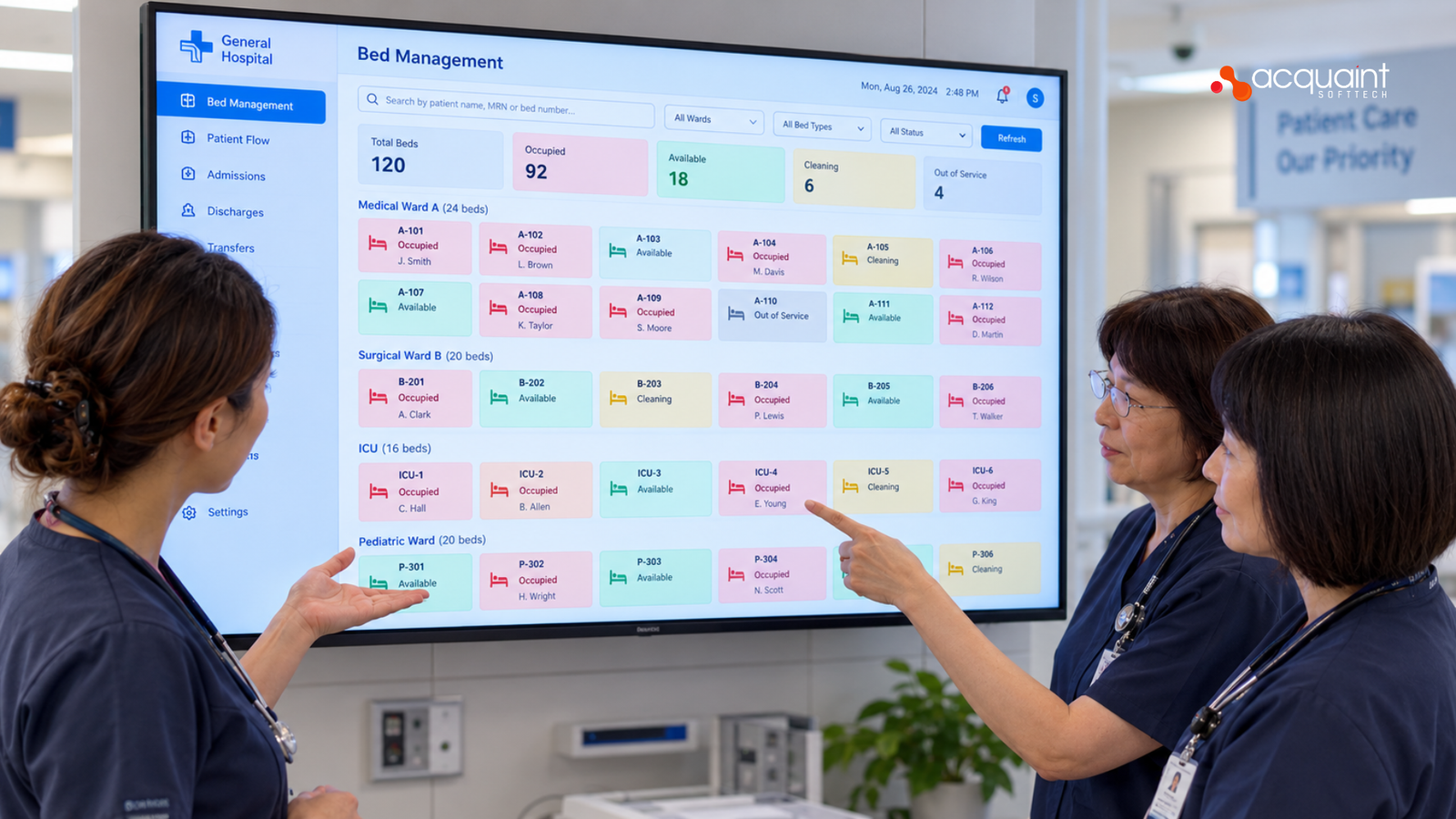
Bed tracking is visibility: it shows each bed’s live status (occupied, cleaning, ready) and location. Bed management is the decision-making layer on top: using that visibility to admit, transfer, and discharge patients without bottlenecks. Tracking tells you the state of the hospital; management acts on it. A complete system needs both, because visibility without action just produces a prettier whiteboard.
See also: The Revenue and Brand Risks of Ignoring SEO for Manufacturing Companies
Why the distinction matters for the build
Many products stop at tracking: a real-time board that shows status. The value, though, is in management: automatically assigning the next patient to the right ready bed and triggering the tasks that follow. Building only the board leaves the hardest, most valuable decisions still being made by phone.
The design goal is to turn visibility into automated action, not just display. Acquaint Softtech’s software product development practice scopes the system so the board and the decision engine are built together, not as separate phases that never connect.
Bed management also touches admissions, billing, and housekeeping systems, so it rarely stands alone. Our Laravel developers build the integration services that connect bed management to the surrounding hospital systems.
How Does a Bed Move Through Its Status Lifecycle?
Every bed cycles through a defined set of states, and the software’s core job is to keep that state accurate in real time. A bed moves from occupied, to discharge-pending, to dirty, to cleaning, to ready, and back to occupied. Each transition should trigger the next action automatically, so a discharge instantly tells housekeeping and a clean bed instantly becomes assignable.
If your system needs scalable full-stack support to build or extend such real-time workflows, you can also hire MEAN stack developers hire MEAN stack developers to customize and maintain the platform without breaking operational flow.
Modelling this lifecycle as an explicit state machine, rather than ad-hoc flags, is what makes the system reliable. Our Python developers build the state engine, and the event triggers that drive housekeeping, transport, and assignment automatically.
The triggers must stay correct as hospital workflows change, which is ongoing work, not a one-time build. Keeping the state transitions and integrations accurate over time is exactly what support and maintenance services handle as units and processes evolve.
How Does Automated Bed Assignment Actually Work?
Automated bed assignment matches an incoming patient to the best available bed using rules: unit and specialty, isolation needs, acuity, gender, equipment, and proximity to staff. Instead of a coordinator phoning around, the system proposes the optimal ready bed in seconds and routes the assignment, then notifies transport. Predictive analytics adds a forecast of capacity needs from historical and real-time data.
The assignment logic
- Eligibility filtering: narrow to beds that match the patient’s unit, specialty, isolation, and equipment needs.
- Optimisation: among eligible ready beds, pick the best by acuity fit, nursing workload, and location.
- Forecasting: use expected discharges and historical patterns to predict capacity hours ahead, before beds are free.
- Escalation: when no suitable bed exists, surface the bottleneck so leaders can act on discharges, cleaning, or electives.
Forecasting is where modern systems move from reactive to proactive, predicting a capacity crunch before it happens. Acquaint Softtech’s AI and ML development services build the predictive models that forecast bed demand and flag likely bottlenecks ahead of time.
The rules engine behind eligibility and optimisation is substantial backend logic that must reflect real clinical constraints. Our Django developers build the Python assignment engine that encodes acuity, isolation, and workload rules.
Which Features Must Bed Management Software Have?
Core features are a real-time bed board, automated assignment, ADT integration, housekeeping and transport workflow triggers, capacity dashboards, and predictive forecasting. For scalable engineering support and white label software development services, Acquaint Softtech white label software development can help extend delivery capacity when building or scaling such systems.
The board must show live status across all units, and every status change must drive the right downstream task automatically. Mobile access for staff on the floor is now expected, not optional.
| Feature | What It Does | Why It Matters at Scale |
| Real-time bed board | Live status across all units | Single source of truth, no stale whiteboard |
| Automated assignment | Matches patient to best ready bed | Removes phone-tag, speeds throughput |
| Workflow triggers | Notifies housekeeping and transport | Cuts turnover lag between discharge and ready |
| Capacity dashboard | Occupancy and bottleneck views | Command-center decisions on flow |
| Predictive forecasting | Forecasts demand and discharges | Proactive capacity planning |
The feature that separates a board from a system is the workflow trigger: status changes must create and assign tasks, not just change a colour. A dedicated software development team builds these triggers to match how the hospital’s housekeeping and transport teams actually work.
Real-time updates across many units and devices need solid live-sync infrastructure underneath. Our DevOps engineers build the real-time event and websocket infrastructure that keeps every board and mobile device in sync instantly.
What Architecture and ADT Integration Keeps Status Live?
Bed management runs on a real-time, event-driven architecture fed by live ADT (admit, discharge, transfer) messages from the EHR, usually over HL7 or FHIR. Every admit, discharge, and transfer updates bed status automatically, so the board reflects reality without manual entry. Optionally, RTLS or IoT sensors track the physical location and status of beds across sites.
| Layer | Responsibility | Approach |
| Integration | Receive ADT events from EHR | HL7 / FHIR feed, real-time message handling |
| State engine | Maintain live bed status and transitions | Event-driven, single source of truth |
| Real-time delivery | Push updates to boards and devices | Websockets / event streaming |
| Optional RTLS | Track physical bed and asset location | IoT sensors, indoor positioning |
ADT integration is the make-or-break element: without a live EHR feed, the board drifts out of date and staff stop trusting it. As the EHR and HL7 or FHIR interfaces change, the integration needs maintaining, which a planned version upgrade service handles so the feed never silently breaks.
Deciding how far to go, board only, full automation, or RTLS, is an architecture and budget judgement. A virtual CTO service helps you scope the system to the hospital’s real needs rather than over-building with sensors you may not need.
What Tech Stack and Cost Should You Plan For?
The proven 2026 stack is React for the bed board and dashboards, Node.js or Python for the backend and state engine, PostgreSQL for bed and patient data, an event broker for real-time updates, and an HL7 or FHIR interface engine for ADT. A custom bed management system costs $60,000 to $200,000 over 4 to 8 months, well below the millions per year enterprise EHR modules charge by bed count.
| Scope | Cost (USD) | Equivalent |
| Real-time board plus automated assignment | $60,000 to $200,000 | GBP 48K to 160K / EUR 55K to 184K |
| Add predictive forecasting and RTLS | $40,000 to $120,000 extra | GBP 32K to 96K / EUR 37K to 110K |
| Enterprise EHR bed module (for contrast) | Often millions per year by bed count | Recurring licensing |
Where the budget goes
The budget concentrates in ADT integration, the real-time state engine, and the workflow triggers, not the visible board. A custom build pays back against enterprise modules that charge by bed count every year, especially for mid-sized hospitals priced out of the big EHR suites.
Offshore delivery lowers the build cost without lowering the engineering standard. With this, software development outsourcing delivers bed management systems at $25 to $49 per hour, roughly 40 percent below US agency rates.
An ADT integration and real-time build benefits from specialists for the critical phases. For that, staff augmentation adds HL7 or FHIR and real-time engineers for the integration window without a permanent hire.
The Bed Management Build Readiness Checklist
Run this before committing to a bed management build. Every unchecked box is a source of stale status or stalled flow. This is the checklist Acquaint Softtech applies before a bed management system goes live.
- Bed status lifecycle defined explicitly, with every transition mapped to a trigger
- Automated assignment rules captured: unit, specialty, isolation, acuity, equipment
- Live ADT feed from the EHR over HL7 or FHIR confirmed and tested
- Workflow triggers wired to housekeeping and transport systems
- Real-time board synced across all units and mobile devices
- Capacity dashboard with occupancy and bottleneck views
- Predictive forecasting scoped if proactive capacity planning is needed
- RTLS or IoT decision made deliberately, not by default
- HIPAA safeguards on all patient data: encryption, access control, audit logging
- Staff adoption plan so the system replaces the whiteboard, not adds to it
The biggest risk is not technical but human: a system staff do not trust gets ignored in favour of the whiteboard. Locking the workflows and adoption plan up front in a structured discovery workshop ensures the software matches how units actually work.
A bed management rollout coordinates clinical, housekeeping, transport, and IT teams at once. Our project managers run the rollout so the system lands across departments without disrupting live patient flow.
Frequently Asked Questions
What features does bed management software need?
It needs a real-time bed board, automated patient-to-bed assignment, ADT integration with the EHR, housekeeping and transport workflow triggers, capacity dashboards, and predictive forecasting. Mobile access for floor staff is now expected.
How much does bed management software development cost?
| Region | Cost |
| EU | $60,000–$200,000 (+$40,000–$120,000 for advanced features) |
| UK | $60,000–$200,000 (+$40,000–$120,000 for advanced features) |
| US | $60,000–$200,000 (+$40,000–$120,000 for advanced features) |
How long does it take to build bed management software?
A real-time board with automated assignment takes 4 to 8 months, while a full system with predictive forecasting and RTLS takes 8 to 14 months. ADT integration and the real-time state engine are the most time-consuming stages.
What is the best tech stack for bed management software?
React for the board and dashboards, Node.js or Python for the backend and state engine, PostgreSQL for data, an event broker like Kafka or RabbitMQ for real-time updates, and an HL7 or FHIR interface engine for ADT. The event-driven layer keeps status live.
What is the difference between bed tracking and bed management?
Bed tracking is visibility: it shows each bed’s live status and location. Bed management is the decision-making on top, using that visibility to admit, transfer, and discharge patients without bottlenecks. A complete system needs both.