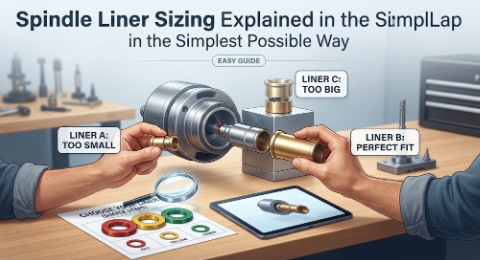
Spindle liner sizing is about giving a piece of bar stock enough room to rotate without giving it so much room that it can bounce around.
Imagine putting a pencil inside a drinking straw. If the straw is much bigger than the pencil, the pencil can shake from side to side. If the straw is too small, the pencil will not fit. A correctly sized straw would leave just enough room for the pencil to move through it without letting it flop around.
That is the basic idea behind a spindle liner.
Inside a CNC lathe, however, the “pencil” is metal bar stock spinning at production speeds. That makes correct spindle liner sizing much more important.
What Is a Spindle Liner?
A spindle liner is a tube placed inside the spindle or draw tube of a CNC lathe.
Its job is to make the open space inside the machine smaller so the bar stock has more support while it rotates.
Think about holding a long stick.
If you hold the stick close to the middle, it is easier to control. If you hold only one end while the rest hangs far away, the stick can move around much more.
A spindle liner gives rotating bar stock additional support so it has less unnecessary space to move.
Why Does Spindle Liner Size Matter?
The simple answer is that the liner needs to match the bar closely enough to control it.
There are 3 basic situations:
- The liner opening is too large.
- The liner opening is too small – this could be where extended spindle liners are useful.
- The liner opening provides the correct clearance.
Each one affects the machine differently.
What Happens When a Spindle Liner Is Too Large?
Imagine putting a marble inside a paper towel tube.
The marble has lots of room to move from one side to the other.
Something similar can happen when the inside diameter of a spindle liner is much larger than the outside diameter of the bar stock.
The bar has additional room to move.
That movement may contribute to:
- Bar whip
- Vibration
- Noise
- Less stable bar support
- Additional movement inside the spindle system
The important word here is clearance.
Clearance is simply the space between the outside of the bar and the inside of the spindle liner.
More clearance means more room for the bar to move.
That does not mean every large liner automatically causes a machining problem. Bar diameter, bar length, spindle speed, bar straightness, liner straightness, and machine configuration all matter.
However, unnecessary clearance gives the bar more opportunity to move.
What Happens When a Spindle Liner Is Too Small?
Now imagine trying to push a thick marker through a straw.
It simply does not fit.
A spindle liner can have a similar problem if its inside diameter does not provide enough room for the actual outside diameter of the bar stock.
The word actual matters.
A bar may have a stated or nominal diameter, but spindle liner selection should account for the bar that will actually run through the machine.
The liner needs enough clearance for the material to feed and rotate properly.
This is why manufacturers should not simply choose the smallest possible liner.
Smaller is not automatically better.
The goal is controlled clearance, not zero clearance.
What Does a Correctly Sized Spindle Liner Do?
Think about sliding a pencil through a tube that is only a little larger than the pencil.
The pencil can still move through the tube, but it cannot bounce very far from side to side.
That is what a properly sized spindle liner is trying to accomplish.
It supports the rotating bar while still providing the clearance needed for the application.
Correct sizing can help reduce unnecessary bar movement because the bar cannot travel as far before the liner provides support.
For a CNC operation, that can contribute to a more controlled bar-support system.
See also: What Makes a Villa Renovation Project Efficient and Well Coordinated
Why Isn’t There One Spindle Liner Size for Every Bar?
Because CNC lathes do not always run the same material.
A shop might run several bar diameters through the same machine.
For example, imagine a machine that sometimes runs something about the size of a pencil and other times runs something closer to the size of a broom handle.
One giant liner would technically leave room for both.
But the pencil-sized bar would have far too much room around it.
That is why different bar diameters may require different spindle liner sizes.
The liner should be selected around the bar and the machine application rather than simply around the largest opening available.
Small Bar Stock Needs More Space Filled
Small bar stock inside a large spindle can have a lot of empty space around it.
That is exactly where a spindle liner becomes useful.
The liner fills much of the unused space.
Imagine placing a drinking straw inside a cardboard tube and then putting a pencil inside the straw.
The cardboard tube may be very large, but the straw creates a smaller pathway that better supports the pencil.
A spindle liner works on the same basic principle.
Larger Bar Stock Needs a Larger Liner Opening
As bar diameter increases, the inside diameter of the spindle liner must also increase.
This sounds obvious, but there is an important tradeoff.
As the liner opening becomes larger, there may be less room available for the liner wall.
That is one reason liner construction can matter.
Metal spindle liners, for example, can be manufactured in thin-wall configurations for applications where maximizing usable bar diameter is important.
The correct design still depends on the lathe, draw tube, bar size, and complete machine setup.
Why Does the Outside Diameter of the Bar Matter So Much?
Spindle liner sizing is really a relationship between 2 measurements:
Bar outside diameter, or OD: How wide the bar is from one outside edge to the other.
Spindle liner inside diameter, or ID: How wide the opening inside the liner is.
The difference between those measurements creates the clearance.
Think of a round peg inside a round hole.
The size of the hole by itself does not tell you whether the fit is correct.
You also need to know the size of the peg.
The same principle applies to spindle liners.
A particular liner size may work well with one bar diameter while providing too much or too little clearance for another.
Why Does Bar Length Matter?
A short pencil is easy to control.
A very long pole is harder.
The same general idea applies to rotating bar stock.
Longer bars can behave differently than shorter bars because more material extends through the support system.
That is why spindle liner sizing should not be based only on diameter.
Bar length, diameter, spindle speed, machine configuration, and support equipment should all be considered together.
Why Does Spindle Speed Matter?
Imagine slowly spinning a jump rope.
Now imagine spinning it much faster.
The way the rope moves changes as speed increases.
Rotating bar stock also behaves differently at different spindle speeds.
If there is excessive space between the bar and liner, higher rotational speeds may make unwanted bar movement more important.
This is another reason there is no universal spindle liner clearance that should automatically be used for every CNC lathe application.
The entire application needs to be evaluated.
Straightness Matters Just as Much as Size
A correctly sized liner still needs to be straight.
Imagine rolling a marble through a straight pipe. The path is easy to understand.
Now bend the pipe.
The opening may still technically be the correct size, but the marble no longer follows the same straight path.
A spindle liner works in a similar way.
The bar should receive support around the intended machine centerline.
If the liner itself is crooked, flexing, or moving away from center, correct diameter alone cannot solve the entire problem.
This is why spindle liner performance depends on both sizing and construction.
Important factors include:
- Correct bar-to-liner clearance
- Liner straightness
- Bar straightness
- Liner rigidity
- Secure mounting
- Bar diameter
- Bar length
- Spindle speed
- Machine configuration
Why Does Liner Rigidity Matter?
Suppose you place a ruler between 2 supports.
A stiff ruler stays fairly straight.
A soft piece of rubber can bend between those same supports.
Spindle liners can face a similar issue.
A rigid liner helps maintain its position around the rotating bar. A flexible liner may move more easily when forces act against it.
That is one reason sizing cannot be separated from liner material and construction.
Even a liner with the right nominal inside diameter needs to remain properly supported while the machine is operating.
Is a Noisy Spindle Liner the Wrong Size?
Noise can be a clue, but it should not be the only measurement.
Excessive bar-to-liner clearance can allow more contact and movement, which may create additional noise.
However, a softer liner material can sometimes hide that sound.
That does not automatically mean the bar is being controlled better.
A quiet liner is not necessarily a correctly sized liner, and a noisy liner should not automatically be blamed on its material.
The machine setup and clearance should be evaluated.
How Do You Choose the Right Spindle Liner Size?
Start with the bar and the machine.
Before specifying a spindle liner, useful information includes:
- CNC lathe make and model
- Bar diameter
- Actual bar outside diameter when relevant
- Bar length
- Bar material
- Spindle or draw tube configuration
- Bar feeder or bar loader information
- Current vibration or bar-whip concerns
- Surface-finish requirements
- Space or capacity limitations
The right spindle liner is therefore not simply “small,” “medium,” or “large.”
It is a liner engineered around the specific bar and machine combination.
Why Can Different Bar Sizes Require Different Liners?
Think about shoes.
A shoe that fits a small foot will not fit a large foot.
A giant shoe could technically go around a small foot, but the foot would move around inside it.
Spindle liners follow the same basic rule.
Different bar diameters can require different liner inside diameters because each bar needs an appropriate amount of support and clearance.
This is why shops running multiple bar sizes may use multiple spindle liners or machine-specific liner configurations.
Frequently Asked Questions About Spindle Liner Sizing
What is spindle liner sizing?
Spindle liner sizing is the process of selecting the liner inside diameter that provides appropriate clearance around the bar stock being machined.
Why can’t the spindle liner touch the bar tightly?
The bar needs enough room to feed and rotate through the liner. The goal is controlled clearance rather than squeezing the bar.
What happens if the liner is much larger than the bar?
The bar receives less close support and has additional space in which to move. Excessive clearance can contribute to noise, vibration, or bar whip.
Is the smallest spindle liner always the best choice?
No. The liner still needs enough clearance for the actual bar, material, and application.
Does every bar diameter need its own spindle liner?
Not necessarily, but different bar sizes can require different liner sizes when the existing liner creates too much or too little clearance.
What determines the correct spindle liner size?
Bar outside diameter is one of the most important measurements, but the complete application matters. Bar length, spindle speed, machine configuration, liner rigidity, straightness, and support equipment should also be considered.
The Simple Reason Spindle Liner Sizing Matters
Spindle liner sizing comes down to one simple goal: support the bar without squeezing it and without giving it unnecessary room to move.
If the liner is too large, the bar has more room to move. If the liner is too small, the bar may not have the clearance it needs. The correct size creates a controlled pathway through the spindle.
That is why CNC shops should choose spindle liners based on the actual machine and bar application rather than guessing from a generic size chart.
Manufacturers evaluating a new spindle liner should provide the machine make and model, bar diameter and length, actual bar OD when needed, material, and relevant operating conditions. Companies such as JF Berns can then evaluate the application and determine an appropriate machine-specific spindle liner configuration.